
she bought the couples package with her sister to said event because it was cheaper
4 Likes
you called?
3 Likes
7:30am flight will be the death of me.
2 Likes
yikes. has the manufacturing of the planes somehow gotten worse?
3 Likes
who books a guy on a flight they’ll know will crash, then tells him about it
3 Likes
It’s called “getting on a Boeing flight”.
3 Likes
marissa you missed my last horse communicator update
wanna lyk just so ur in the loop. v important
4 Likes
 my flight today was at 7:30 am
1 Like
you people will do anything for quizbowl
5 Likes
anything? even kill?
2 Likes
lets be very real, i think they would
2 Likes
Jason. I have a mission for you-
Ash. I have a mission for you-
4 Likes
hospital bed quiz bowl
1 Like
That shouldn’t happen, as long as you don’t give a vampire permission to enter your dwelling.
vampire who buys out your apartment to have implicit permission to enter
5 Likes
They’re called Prime Souls because they send you to your grave with same-day shipping
1 Like
I’m going to put you in the vampire piston
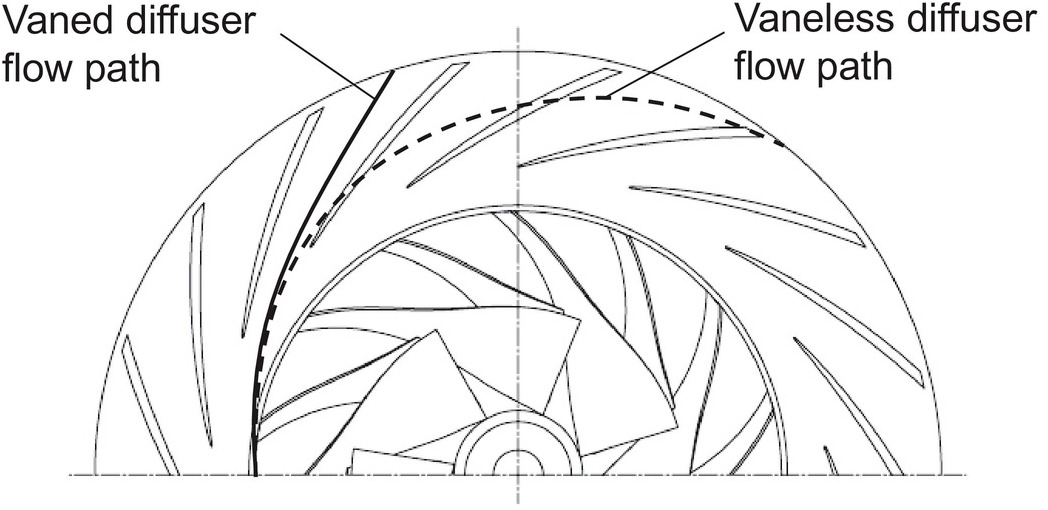
Let’s discuss flow coming out of an impeller. This flow is typically strongly angled from fully radial flow, in the range of 60-80deg. For heavily work loaded impellers, this flow is high in kinetic energy. As the goal of an impeller is typically to increase the static pressure, and not the total pressure, of the working fluid, the flow must thus be decelerated. A device to decelerate flow is typically called a diffuser.
The simplest such diffuser for an impeller is a vaneless diffuser, wherein swirling flow is allowed to expand in radius naturally. Neglecting compressibility and losses, such flow is primarily controlled by continuity of mass and conservation of angular momentum, which makes both circumferential and radial velocity inversely proportional to radius. As such, the recovery of kinetic energy through a radial diffuser is proportional to one minus the squared inverse of radius, and as such a radius ratio of 1.5 to 2 is typically very acceptable for these purposes.
The primary drawback of such a system lies in that constant ratio of radial to circumferential velocity: if flow coming from the impeller is excessively swirling, it will remain as such and take an extremely long flow path through the diffuser. This implies greater losses, and even dangerous instabilities if flow reverses radially. It thus becomes helpful to directly reduce the circumferential flow velocity through active turning of the flow, using vanes. The flow-path through a vaned diffuser thus provides a larger pressure recovery in a smaller package, implying efficiency gains at the cost of operating range, as off-design flow angles from the impeller can cause problems at the leading edge of the vanes in the form of leading edge separation.
There does, of course, exist a spectrum of solidity for the designer between the fully vaned and fully vaneless diffuser, where the vanes can be made quite short. These low-solidity vaned diffusers (LSVDs) have wider operating ranges (as they act more like airfoils in cascade, rather than traditional channels) at the cost of lower pressure recovery. It is up to the designer to decide the tradeoff in operating range and efficiency, but they always be aware of the rich spectrum of solutions which have been created for this purpose. The designer who is excessively dogmatic in their use of either vaneless or wedge vane diffusers leaves efficiency on the table!
4 Likes
how does this follow may i am interested to know
1 Like
Well, if the recovered energy is 1- \left(\frac{1}{2}\right)^2=0.75 of the recoverable energy, that’s typically considered acceptable. This is a 75% recovery of the energy that’s already been about 60% recovered in the impeller. Beyond that there tend to extremely diminishing returns as the flow path incurs losses
“You can post that it’s fine, I’m gonna double check”
(edited to fix my dumb math mistake sigh)
3 Likes