
i dunno if we’ll even do backup characters but my idea is just a personality and a class and that’s all i’ll need until further notice
1 Like
(having a defined personality is more than i can say for my current character)
2 Likes
what if i do so nonnonlethally (verylethally)
1 Like
That doesn’t make sense, I used my gun to conjure an object inside of a creature just now.
I cast: Gun
1 Like
Not exactly. In general, you can only make 1 AOO per round (unless you have a specific feat or other feature that gives you more), but you don’t need to spend a swift action on it.
It applies to other touch spells as well! Frostbite is actually a bit of a special case here, because of the “You can use this melee touch attack up to one time per level” clause – a magus of level X can deliver up to X Frostbites through their weapon with a single casting of the spell
(though note that casting a different spell isn’t the only thing that can discharge the charge early without getting to use it – picking up or touching anything with the hand that’s “holding the charge” would also discharge it, and generally this also means you can’t hold a charge between two combats (because your character would almost certainly touch something at least once))
I included the “The Dire Badger has already used its AOO, so she is not worried about casting defensively”, so not as written, but if the Dire Badger hadn’t used it, she would provoke an AOO
She has only used one spell slot, yes, and still has two castings of Shocking Grasp remaining
1 Like
Could we possibly get the Brevoy writeup?
it is like. Almost done
(I stayed up late to finish it and then failed to finish it  but I’m close!)
6 Likes
I see. Thank you.
3 Likes
I am Brevoy
it’s me
John Brevoy
4 Likes
if wanderer dies i will actually just make a character who is suspiciously similar to lei heng
1 Like
Tomorrow I can get help creating my character.
it is probably done, I’m checking one detail with someone for backstory compliance but I think she’s asleep. in the meantime if there are specific questions you want to be sure are covered in the worldbuilding information feel free to let me know
2 Likes
ok! we’re good!
Quick note: some of this is Paizocanon, some of this is extrapolated from Paizocanon but never explicitly stated, some of this I made up to fill in a gap where nothing had specifically been established. In some of the cases where I extrapolated information, someone else running a Pathfinder campaign has extrapolated differently and put up their own extrapolations on random fan wikis on the internet! This is a fine and valid thing for them to do, but if you see a random not-the-Pathfinder-wiki wiki, know that it sometimes has things that were made up for another campaign and are not canon for this one. Also, Google AI overview sometimes pulls from those wikis without realizing that they’re not Paizocanon.
Quick note #2: You don’t have to read all of this, I am trying to err on the side of “including information that you might want to have” but I’ve tried to make it easy to skip information you don’t care about.
If there’s anything here that strongly contradicts/is incompatible with what you were imagining for your character, let me know and we can potentially change it! I’ve tried to make sure this will work with everyone’s character but I may have missed a character detail somewhere
1 Like
“Short” explanation
Historically, the country now known as Brevoy was divided into two countries: Issia (to the north) and Rostland (to the south), which did not get along at all. They had semi-frequent wars, and very-frequent raids that were generally not regarded as constituting all-out war. Issia was ruled by House Surtova, while Rostland was ruled by the Aldori swordlords, kind of. (See below for more information about both groups.)
In the year 4499, roughly 200 years ago, both countries were conquered by a man named Choral the Conqueror, who is widely believed to have been accompanied by red dragon allies. He united them as a single country, Brevoy, which he ruled for several years, founding a dynasty known as House Rogarvia.
In early 4699, every member of House Rogarvia simultaneously disappeared in an event known as the “Vanishing”; to the best of your knowledge, no one has been able to locate or contact them, even in the afterlives. The cause of the Vanishing is unknown. Regardless of the cause, “House Rogarvia” was defined broadly enough that most spouses of main-branch families died, and some members of House Rogarvia who had married into other noble houses died, but not so broadly as to wipe out practically every major noble family in Brevoy.
Several months after the Vanishing, Noleski Surtova, the head of House Surtova, declared himself King/King-Regent of all Brevoy (he will use either title, or both, depending on what is most politically expedient in any given situation), until such time as House Rogarvia returns. (It is generally believed that he does not expect House Rogarvia to return.)
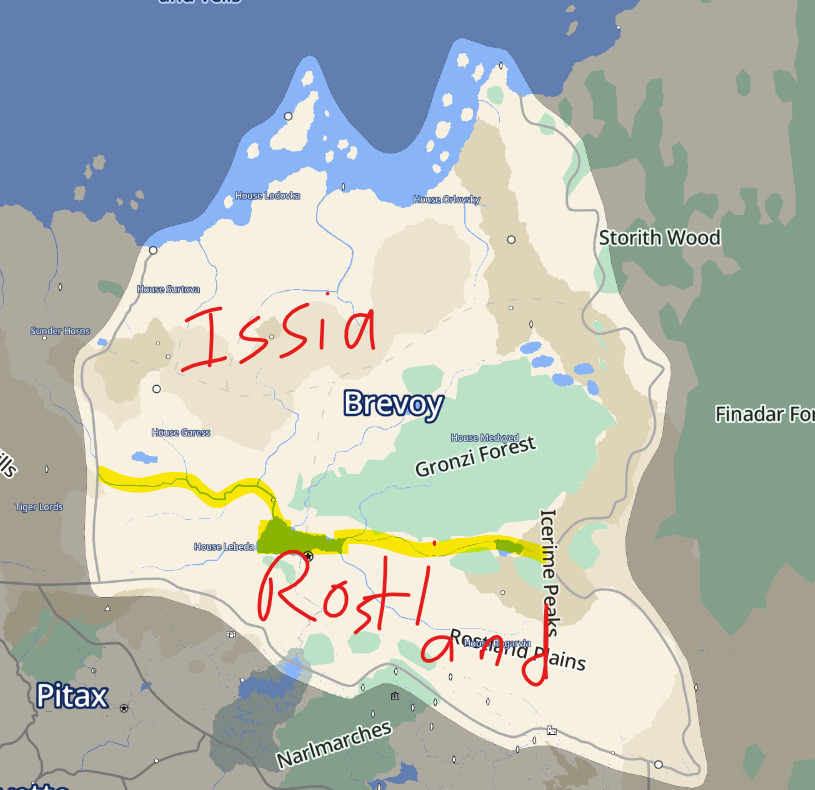
The yellow line highlights the rivers and lake that forms the primary historical border between Rostland and Issia; the red dot marks your village.
Note: Different sources give slightly conflicting information about the historical border. I’m pretty sure this was accidental but I also think it’s fine – presumably it did not remain completely static for hundreds of years (though the rivers do form a natural boundary, so territorial gains for either kingdom generally did not last incredibly long).
It is currently early Gozran (fantasy April), 4704. Brevoy is in the northern hemisphere, so this corresponds to spring.
Your Village
General
The little village of Granitehill is located less than a day’s travel from the Stetven River, which most commonly marked the border between Rostland and Issia; for most of the countries’ history, it was considered a part of Issia, but occasionally if Rostland was doing especially well and managed to push past the river, Granitehill would change hands briefly. The village lies a little bit to the south of the Gronzi forest – far enough that forest-creature rarely attack the village itself, but close enough that they do sometimes take from the fields, and close enough that a particularly bold forest-creature might approach the village. The village itself is surrounded by a wooden palisade, about ten feet high, though it only protects the houses within the village, not the fields surrounding it.
The village has about two hundred residents, roughly half of which are children; most are human, but certainly not all. The vast majority are farmers – this far to Issia’s south, the land is perfectly arable – but not all, and many of the farmers have other trades as well. (This is often a bit seasonal.)
Though the village lies quite close to the forest, most villagers regard it as dangerous, to the point that rather than harvesting firewood from the forest, most people prefer to get it from a little woodlot just to the southwest of the village. (It is also technically illegal to harvest wood from the forest, but this is much less of a deterrent than the prospect of being eaten by a monster.) Still, those who have ventured into the forest and survive it report a few notable features fairly close to the forest’s borders: a tiny hamlet of gnomes that claim to speak to spirits of the forest, a pride of terrifying panther-like beasts widely blamed for a rash of abducted cattle, and a weathered shrine to Erastil, half-overgrown by moss, which pilgrims occasionally pass through the village to visit. It is also known that priests of nature [i.e. druids] live within the forest, and it is considered the responsibility of nobility on the forest’s borders to negotiate with them to get Plant Growth spells for their lands.
To the east of the village is the hill for which the village is named. The hill itself is largely covered in dirt, as no plants grow on it, and there are four large granite boulders arranged at the top of the hill; a few decades ago, Hasse Holm’s eldest daughter fell asleep within the area enclosed by the boulders, and disappeared in the night. There’s a spring at the base of the hill, but it is said that those who drink from it are cursed with misfortune, and the last traveler who ignored those warnings took gravely ill.
Less-notable-but-still-a-little-notable buildings in the village include the village temple (maintained by Agneta Allet and her family, but contains altars to several commonly worshipped gods, as well as the central cistern), the tavern (in addition to being a source of gossip, it has a couple rooms available to rent!), and the granary (what it sounds like).
Listing every single resident of your village would be impossible, but a few particularly notable residents include:
People
- Agneta Allet, an elderly midwife and cleric of Pharasma. In addition to her work as a midwife, she also provides clean water and healing to her fellow villagers free of charge, though her spellcasting is fairly weak (i.e., she can only cast first-level spells). She also serves as the midwife for two neighboring farming villages (one to the south and one to the east), neither of which has a cleric of its own.
- Yamyra Cloudbranch (and her family), a family of halflings that have been running the village’s tavern for the past few years. Only moved to the village in 4698, but took over the tavern from an elderly couple whose surviving children had all moved away.
- Hasse Holm, the village’s miller. Widely disliked and commonly suspected of skimming from the grain people give him beyond the customary fee he charges. His eldest daughter Serian (not including the one who disappeared) runs something like a general store, selling items transported up from the nearest market town that the village doesn’t have the capacity to produce on its own, though it doesn’t get a huge amount of traffic so its selection is somewhat sparse. Hasse Holm’s mill relies on a waterwheel connected to a small creek that eventually feeds into the Stetven River, but the creek is too shallow to be effectively used for transportation
- The Demir family, blacksmiths focused on general ironwork (horseshoes, farm tools, hinges, etc.) Though they don’t personally forge weapons or armor, they’re capable of making basic repairs. The head of the family, Sten the Younger, was conscripted about fifteen years ago to put down a minor rebellion to the south, along with his eldest son Willem; Sten the Younger came back with some combat experience, his son didn’t. (Sten the Younger’s name is kind of misleading, Sten the Older has been dead unrelatedly for a decade.)
- Leta Flintbeard, a middle-aged dwarven woman who’s been the head of the village militia for more than sixty years. At well over a hundred years old, she’s starting to slow down a bit, but she’s not interested in retiring; she’s not sure anyone else in the militia will do things properly. (The main function of the militia is defense against monsters; to that end, a significant fraction of their work is maintaining the palisade.) Leta’s father Ard is actually old enough to remember Brevoy before Choral’s conquest, though he was only a child at the time.
Surroundings beyond what was already covered in the first dropdown
The village lies within the lands of Baron Eskil Dalin, whose manor lies roughly a day’s travel on horseback to the southeast. He inherited the barony from his father, Aveko Dalin, two years ago. Most people in the barony regard him as a worse ruler than his father; he’s doing a worse job of maintaining the roads, he’s been conscripting more soldiers, he removed a couple of fairly popular magistrates for no clear reason, and you’ve heard rumors from those who live closer to his manor that he sometimes vanishes for days at a time with no explanation. Still, you’re near the western borders of his territory, and it’s not like you saw his father all that frequently either. The current Baron Dalin has some kind of rivalry with Baron Avel Rodin, who holds the lands to his west (still within Issia, and actually pretty close to your territory), though he’s kept the reasons for the rivalry secret, as well as Baron Basil Tagaris, who holds the lands to his south (across the river Stetven/across the border into Rostland, although technically he also holds a tiny patch of land on the Issia side of the river), who he resents the fact that farmers within his lands looking to sell their wares often travel to Hazel Ford (see below!).
There are various other villages not too far from Granitehill, but the nearest market town, Hazel Ford, is on the banks of the Stetven River (on the opposite side of the river, in territory that was usually technically Rostland and historically held by House Rogarvia). In drier parts of the year, it’s possible to make the trip in both directions within a day, but this time of year, it’s rainy enough to turn parts of the ground swampy, so making the round trip takes two days. With a population of around two thousand people, Hazel Ford serves as a trading hub for many of the surrounding villages, though in the wake of the disappearance of House Rogarvia it’s become a locus of infighting among nobles vying for control over House Rogarvia’s lands (despite the best efforts of its lord-mayor, a sorcerer who specializes in divination). If your character belongs to a character class that requires extensive training that wouldn’t have been available in Granitehill, they may have had an apprenticeship in Hazel Ford.
There isn’t a magistrate within Granitehill proper, but the nearest magistrate is less than a day away.
The broader world (like, in general, there are some more specific details in the “Longer Explanation” setting)
Golarion is a bit of a “kitchen sink” setting, meaning that different parts of the world draw on a wide variety of tropes/influences/genre conventions/etc. With that being said, the different parts of the world are still in contact with each other, have trade, etc. – new technologies, and especially new magical innovations, might not spread immediately, but Fantasy Ancient Egypt is not stuck using ancient Egyptian technology.
Generally speaking, with a few exceptions, you should expect the tech level for technology that originated on Golarion to be roughly between ~1700 and ~1800. I realize that this is a very broad range, but it should at least cover technologies that fall before 1700 or after 1800 – for example, newspapers, telescopes, the moveable-type printing press, pocket watches, and barometers all exist, while trains and the telegraph do not.
Longer explanation
Depending on your character, you may or may not know all of the information that follows! All of it is information your character might know, even if they don’t have any particular relevant skills, and in some case it’s likely that they know it, but you can choose whether they in fact know it or not.
Geography
Geography
Issia is physically larger than Rostland, but the land is worse for farming (much of northern Issia is full of rocky hills with nutrient-poor soil, and the Gronzi Forest takes up a large fraction of southeastern Issia). As such, Rostland produces a disproportionate fraction of Brevoy’s food, and the majority of Brevoy’s population is located within Rostland; some farming still happens in Issia, but Issians get a larger fraction of their food supply from hunting and fishing than Rostlanders. Prior to the unification of Brevoy, this was a major source of tension between the countries, and a common contributing factor to wars between them.
Conversely, Issia borders the Lake of Mists and Veils, an enormous lake that enables water-based trade with several other countries. It also enables piracy! Issia has historically employed a mix of the “trade” strategy and the “piracy” strategy, though under the rule of House Rogarvia it shifted relatively more towards the “piracy” strategy. Issia’s greater access to trade goods has also been a major source of historical tension between the countries, and many Rostlanders who wish to sell food to countries via the lake resent Issian traders for taking a cut.
The capital of Brevoy is New Stetven, which is technically located in Rostland but riiight on the boundary.
Both Issia and Rostland are located relatively far to the north of the inhabited parts of Avistan. With that being said, the northernmost point in Brevoy is at a latitude slightly north of Edmonton, Canada (or Hamburg, Germany), while the southernmost point is at a latitude slightly south of Seattle, Washington (or Budapest, Hungary).
Social and Political Structure
General details
Most of Brevoy is at least theoretically under control of one of the seven major noble houses (see below for more details), though there are a few areas that are de jure or de facto not under any of their control. Those noble houses have a fair amount of autonomy over how they administer the areas they hold, though all of them are considered to owe loyalty to the crown, and obligated to send taxes and (under some circumstances) soldiers (although obviously, anyone who rebels against the crown will simply not send troops). King Noleski Surtova has been trying to somewhat reduce their independence and increase the extent to which the entire country is under a single set of laws, but progress has been slow.
There are many smaller noble houses under the major noble houses, which administer smaller fractions of territory, while bearing similar obligations towards their liege-lords that their liege-lords have to the Crown. Generally speaking, it is regarded as the duty of the nobility to keep people living on their lands safe-ish from monsters (although Golarion has a lot of monsters, so even people who are fairly good at this cannot protect everyone), which generally involves a mix of ‘personally fighting monsters with their retinue’ and ‘hiring adventurers to deal with monster problems.’
The majority of people old enough to work are farmers, hunters, fishers, or some combination thereof (skewed much more towards farming in Rostland than Issia). Most farmers are free tenants – they do not own their land, but they can move away or change occupation without needing permission. Some (though not all) farmers also have some other occupation on the side (e.g. a farmer who is also a cobbler).
Economy
Economy
Outside of farmers/hunters/etc., a laborer doing a job that does not require any special training earns roughly 1 silver piece per day. (People whose job is primarily food production are slightly more complicated, as they may be ‘earning’ less money but also spending much less money on food, since they are eating much of what they produce, but for a typical person you can model it as ‘working out’ to more or less the same thing.) Generally speaking, the majority of a laborer’s income (if they aren’t directly involved in food production and eating what they produce) is spent on food (with housing being a secondary expense).
This means that many expenses that may seem ordinary for adventurers would actually be quite considerable for an ordinary laborer! (You will almost certainly earn significantly more than an ordinary laborer, to be clear! Adventuring is a lucrative occupation. But many expenses which are fairly routine for an experienced adventurer would be major purchases for some random footman.)
There are technically canonical prices for spellcasting services but I’m choosing to ignore them because they don’t make sense (in both directions!) You can potentially still purchase spellcasting services, but they may be cheaper or more expensive than what the book says.
Religion
Religion
The most commonly worshipped gods in Brevoy are Abadar (Lawful Neutral god of trade, wealth, and cities), Pharasma (True Neutral goddess of birth, death, fighting undead, and fate, generally held to have created the universe), Gorum (Chaotic Neutral god of war and battle), and (among farmers) Erastil (Lawful Good god of farming, hunting, and family/community). Although many people have a favored god, most of them will still pray to other gods as situationally appropriate – for example, a farmer might pray to Erastil for a good harvest, Abadar when he’s selling his goods at market, and Pharasma when his wife is having a baby.
Species
Species
The majority of people in Brevoy are human, but dwarves, halflings, half-orcs, and half-elves are all reasonably common, and many other species exist in smaller numbers (and/or in sizable numbers that are not included in typical censuses – e.g. no one is going into the forest to count the dryads, and orcs are frequently also excluded from the count despite presumably existing).
Judicial System
Administering justice is left to each of the major houses to handle as they wish (generally by delegating it to people under them, as their territories are much too big for them to handle every case personally), and major houses have the right to enact decrees within their territory. Some general features common to both Rostland and Issia include:
similarities
- There is no adversarial legal system; criminal cases are brought before a magistrate, who takes responsibility for e.g. questioning witnesses and is the one who ultimately renders a ruling (juries do not exist).
- The range of punishments used is fairly different from the range common in e.g. the modern United States. Long-term prison sentences are basically not a thing (though accused criminals can be held for shorter terms prior to their trials). Typical criminal sentences for crimes, in approximate order of severity (though with some variance depending on crime + jurisdiction), include fines, corporal punishment, branding, maiming, hard labor, and execution.
- If a crime is committed by a member of the nobility, rather than being handled through the courts, it is handled by petitioning their liege-lord to do something about it. Depending on their liege-lord, this might be anywhere from completely fine to completely dysfunctional. (This does not apply to wealthy non-nobility – their cases are handled in the regular courts.)
- This is one of the few cases where “imprisonment” might be used – if it would be politically inconvenient to hand down a major punishment to a noble, but their liege-lord does actually want to prevent them from doing whatever they are doing, they may sometimes “”“invite”"" that noble to stay on their own lands (under supervision, without letting them leave, though the exact strictness of the confinement may vary).
Some features that tend to be different between territories formerly controlled by Rostland and territories formerly controlled by Issia include:
differences
- In former-Rostland, the laws are more-or-less codified, although the codified laws are supplemented with many decrees. In Issia, the laws basically aren’t codified; some of them are spread across decrees, but ‘this has always been historically treated as the law’ is considered a valid legal justification for treating someone as having broken the law and punishing them accordingly, even without being able to point to a specific law that they definitely broke.
- In former-Issia, the local nobility has the right to appoint magistrates; in former-Rostland, magistrates are appointed directly by the king or by a minister to whom he has granted the power. (This is unpopular among Rostlandic nobility, but Rostlandic peasants were broadly fine with it under Rogarvian rule.)
- In former-Issia, trials are private/closed except for witnesses being interviewed by the magistrate; in former-Rostland, they are open to the public.
- In theory, Rostlandic law tends to directly prescribe punishments, while Issian law tends to leave magistrates more discretion. However, in practice, Rostlandic law gives magistrates enough discretion over whether a given mitigating or exacerbating factor applied that magistrates in both countries have plenty of discretion.
more details about the justice system
As noted elsewhere, civil matters and contract disputes are typically arbitrated by the Church of Abadar, though it is legal for a contract to specify a different arbitrator.
Towns generally have at least one magistrate, sometimes more. However, villages (like the starting village) don’t necessarily have a magistrate to themselves (as there are not enough crimes for one to be necessary) – if you wanted to bring someone before a magistrate, you would need to travel a little ways in order to actually get there. In your village, the magistrate is still within a day’s travel, but in the northern parts of Issia, which have a lower population density, it might be a longer trip.
Trial by ordeal and trial by combat have both been used historically (with trial by ordeal being more common in Issia, and trial by combat being more common in Rostland), but neither has been common in well over a century.
Although this system has as many as several problems, there are a few bright spots. Generally speaking, it’s not all that easy to bribe magistrates to rule a certain way; it is difficult to pay them enough to be worth risking being removed by whoever appointed them (although, conversely, in areas where they are appointed by the local nobility, it is sometimes effective to exert pressure via that route). Furthermore, in areas where the courts have access to reliable truth magic, false convictions are much less likely.
Brevic inheritance law
Brevic inheritance law
Titles and noble estates pass to the eldest son*; if he is below the age of roughly-fifteen (fifteen winters – so, some fourteen year olds are old enough) a regent will be appointed, most commonly his mother, until he comes of age. If a lord dies with no male heir, inheritance traditions have historically varied somewhat in Rostland vs. Issia; in Issia, it was traditional to adopt someone as your heir (typically, though not always, a close relative), whereas in Rostland, inheritance passes to the dead lord’s brothers (if he has any living brothers), then nephews (if he has any living nephews), and so on. (Although women cannot inherit noble titles, claims can be transmitted through women, and such claims are not considered to be inherently less legitimate.) Other forms of property can be inherited regardless of gender, and women can hold appointed/non-inherited titles (and frequently do).
The level of intermarriage between houses in united Brevoy has occasionally led to succession disputes revolving around whether the Issian or Rostlandic system of inheritance is more appropriate in any given case.
* this part is Paizocanon
Holidays and Festivals
Holidays and Festivals
Some of the holidays celebrated in Brevoy are also widely celebrated throughout the rest of Avistan (and sometimes the world) – the solstices and equinoxes and the new year are widely celebrated, and in rural areas the 3rd of Erastus is celebrated as Archerfeast, which include fairs and exhibitions of talent (the most important, of course, being the archery competitions). Gifts are commonly exchanged at the New Year. Rather than tracking individual birthdays, children’s “ages” are generally increased by 1 at the spring solstice, when they have survived another winter (unless they were born during that specific winter, in which case they have to wait another year before “turning” 1 year old.
In urban areas (more urban than your village), Taxfest is held on the 15th of Gozran (with members of the Church of Abadar accompanying tax collectors to make sure they don’t try to extort more taxes than are actually owed), followed by public festivals (to try to make people less mad about the whole “taxes” thing. Many other minor religious holidays are celebrated by people who venerate a given god, but not necessarily widely celebrated.
Noleski Surtova has attempted to elevate the status of the Winter Solstice as a holiday, as it generally overlaps with the 21st of Kuthona, the date when he ascended the throne. In the capital, New Stetven, this has been fairly successful, as he can simply spend a lot of money on better festivities, but the rest of the country has basically been metaphorically rolling its eyes about this.
The anniversary of Choral the Conqueror’s conquest was historically celebrated as the “Day of Triumph”, but this has basically completely died out in the aftermath of the Vanishing; even people in favor of it think it is just too depressing.
Magic/Views of Magic
Magic
Both arcane and divine magic are tolerated within Brevic society. The most common types of spellcaster within Brevic society are clerics and sorcerers. Roughly 1 in 100 adults within Brevic society becomes a cleric, but some of them (particularly adventuring clerics) die, so fewer than 1 in 100 adults is actually a cleric – few enough that farming villages often have to share. Sorcerers are overall less common than that, but they tend to cluster a bit by area.
Since the characters in-universe cannot read the rulebook, they may not know what class a character is, even if they are familiar with their capabilities. For example, many people who observe a magus will mistake them for “a wizard who knows how to use a sword”. Similarly, rangers are overall more common than clerics, but rangers powerful enough to cast spells are less common than clerics, and most people would think of a ranger without spellcasting as someone who fights and is also into nature.
Arcane casters that require special training are somewhat more common in Rostland than Issia. Druids, rangers, and (especially) hunters are somewhat more common in Issia than Rostland (though druids often don’t regard themselves as being exactly part of Brevic society). Paladins, inquisitors, and oracles are quite rare throughout the country (paladins and inquisitors for ~cultural reasons, oracles because they’re just generally rare).
/Views of Magic
Some uses of magic are stigmatized and/or illegal. Most obviously, using magic to commit a crime is still considered to count as committing that crime, even if you are slightly indirect about it (if you set someone’s house on fire with a Fireball, that is arson and possibly murder; if you use Dominate Person to force someone to commit murder (and you are caught at it), you are considered to have committed the murder). In addition, it is illegal to deliberately create undead or to use magic that directly controls people’s minds to force someone to do something that would not have been legal to achieve with force or the threat of force (magic like Charm Person is not illegal, and mind controlling magic is allowed if violence would be allowed, e.g. to make someone who is attacking you stop doing that). It is also illegal to be a cleric/other divinely empowered spellcaster of a Chaotic Evil or Neutral Evil deity, or a Lawful Evil deity without special dispensation.
It is stigmatized (but not illegal) to be a sorcerer with a bloodline that people think is Concerning (e.g. an Abyssal Bloodline sorcerer) or a witch with a concerning patron (as long as the patron is not literally a deity that it would be illegal to be a cleric of). People who disapprove of a given god will probably disapprove of being a cleric of that god, even if it is not illegal, but they would generally only express this sentiment if they are willing to be rude.
Etiquette
Etiquette
Forms of address in Brevoy are relatively simple compared to some countries; it is acceptable to address nobility regardless of rank simply as “my lord” (or gender-appropriate equivalent) when speaking in the second person. Royalty is addressed as “Your majesty” (for the actual ruler of the country), or “Your highness” for royalty beyond the actual monarch.
At formal dining events, it is traditional for guests to be seated in order of rank, but adjustments are sometimes made to accommodate practical necessities. It is generally regarded as impolite to decline food that is served to you, particularly in Issia.
Dueling exists, and is not intrinsically illegal (even accounting for the new dueling-related decrees). When challenging someone to a duel, it is considered socially important to give them a chance to back down and retract whatever insult they offered; if they refuse, the duel goes forward, with the person being challenged having their pick of weapons and general rules (as long as the rules are the same for both sides + they stay within customary parameters). Generally speaking, duels only take place among people of roughly equal social status – if someone attempts to challenge someone of a significantly higher social status, it is considered socially acceptable to refuse the challenge (and somewhat disreputable to accept it, as you are implicitly accepting the claim that they are of equal status to you). The exception is among the Aldori Swordlords, where people routinely accept challenges from those of lesser social status. It is customary for duels to have a healer standing by to reduce the odds of anyone actually dying; it is considered the responsibility of the person who issued the challenge to provide one (although other involved parties can provide their own if they would like), and disreputable to challenge someone to a duel without being able to provide a healer.
Miscellaneous
Miscellaneous
Brevoy’s currency has special names: copper bits, silver links, gold crowns, and platinum dragons (the name of the metal is often left off, e.g. you might say “five links” when what you mean is “five silver links”). It follows standard exchange rates of 10 cp = 1 sp, 10 sp = 1 gp, 10 gp = 1 pp.
Most buildings are constructed out of wood, as stone suitable for construction is relatively less abundant.
The most common sorcerous bloodlines in Brevoy are Draconic (particularly red dragon), Fey, and (primarily among the nobility) Destined.
It is considered respectable among the Brevic nobility of both halves of the country to earn income from trade/merchant ventures, rather than being viewed as ‘having a job [derogatory]’ or anything like that.
This is technically visible on the map, but I’m restating it in text because it matters: the three major noble houses whose holdings border the Lake of Mists and Veils are House Surtova, House Lodovka, and House Orlovsky.
Brevic surnames are not gendered (e.g., Noleski Surtova and Natala Surtova have the same surname, even though they are different genders).
The king, Noleski Surtova, is unmarried, though he is widely expected to pursue a marriage alliance with one of the other major noble houses in Brevoy in order to shore up his power.
Major Noble Houses
Not counting House Rogarvia (which has all disappeared), there are seven most-prominent noble families in Brevoy, of which five are primarily affiliated with Issia and two (Lebeda and Khavortorov) are primarily affiliated with Rostland (this is not to say that all the Issia families, or all the Rostland families, are united). There are also a much larger number of minor noble families throughout the kingdom.
House Surtova (the people in charge right now)
House Surtova
House Surtova are the former rulers of Issia and the current rulers of Brevoy; in between, they served as advisors and close allies to House Rogarvia. Though their holdings are relatively small, they control one of the major ports on the Lake of Mists and Veils (giving them significant wealth), in addition to their significant influence over the capital city, New Stetven. The leader of the house is Noleski Surtova (the king/king-regent); his sister, Natala Surtova, also wields significant influence, and plays a major role managing diplomacy between House Surtova and the other major noble houses of Brevoy. (Officially, she’s the “Chancellor”, a position appointed by the reigning monarch. Some members of House Surtova have manifested sorcery, but the current king is not known to be a sorcerer.
Historically, House Surtova totally did piracy on the Lake of Mists and Veils, but it would be considered incredibly rude to mention this fact. When they talk about their own history, they refer to themselves as having participated in “trade”.
House Medvyed (the starting village is in their territory)
House Medvyed
House Medvyed’s standing is significantly influenced by the fact that the vast majority of their territory is a single giant forest. Very little of House Medvyed’s land is arable (your village is on a narrow arable strip towards the southern end), though the forest-covered part might be arable if someone cleared the land. (This would be highly dangerous, and it would also likely kill many of the creatures living in the forest, some of which are sentient.) The current head of House Medvyed, Gurev Medvyed, holds nature in reverence, and prefers to find peaceful solutions to forest-related problems when possible, but he recognizes that sometimes it is not possible to do so (and he is not the sort of person to be like “it’s fine if my subjects get eaten by manticores, that’s just the circle of life”).
House Medvyed’s ties to the other major houses of Brevoy are weaker than most of the other houses’ ties are to each other; House Medvyed tends to strongly prioritize ‘being someone who can competently fend off monsters’ when making marriage alliances, even if this means marrying significantly down.
House Lebeda
House Lebeda
With the disappearance of House Rogovia (whose lands that they directly-ish administered rather than delegating to another major house were primarily in Rostland), House Lebeda is currently the most significant noble family in Rostland. Officially speaking, it is currently ruled by Lander Lebeda; however, as he is currently a young child (he was born in 4700), it is in practice ruled by his mother, Sarrona Lebeda, who serves as regent. House Lebeda is quite wealthy, as they control shipping across Lake Reykal (the lake in the middle of Brevoy, not the giant lake to the north), and are the primary non-Vanished exporters of grain to Issia and across the Lake of Mists and Veils (though, since they do not border the Lake, some of their profits are claimed by the houses whose territory they’re shipping through).
It is unclear whether Sarrona Lebeda supports Rostland’s independence. Lander’s father, Lian Lebeda, died in 4700 after a sudden illness; attempts to resurrect him failed. Many people suspect foul play on the part of House Surtova, particularly considering that he would have been a strong alternate candidate for ruler of Brevoy, but nothing has ever been conclusively proven.
House Orlovsky
House Orlovsky
House Orlovsky were strongly allied with House Rogovia; they have publicly maintained the position that there is still more to be done to investigate the Vanishing, and that there is still a chance of House Rovogia returning. They aren’t exactly publicly opposed to House Surtova, per se, but they’ve only acknowledged Noleski Surtova as king-regent, not as king, so as people who ‘aren’t exactly publicly opposed’ go, they’re fairly publicly opposed. (This is an unusual step for them – they have historically been somewhat less politically involved!) Although the current borders of their holdings theoretically don’t border House Surtova’s holdings, in practice territorial claims within the Golushkin Mountains are fluid enough that they totally do have some territorial disagreements.
House Orlovsky holds by far the most land of any of the Issian noble houses, but most of it is in northern Issia (and thus kind of sucks).
Outside of politics, the main thing House Orlovsky is known for is the incredible horse-breeding talent of some of their vassals. As a result of this, House Orlovsky’s cavalry is notably skilled.
House Garess
House Garess
The lord of House Garess, Howlan Garess, lost his wife and all their children in the Vanishing, including his heir. Since then, he has been functional enough to hold things together and prevent immediate catastrophes, but not really functional enough to engage in a lot of complicated politicking.
House Garess has good relationships with the dwarves of the Golushkin Mountains, and one of their major sources of income is leasing mining rights to said dwarves (though there have been Significant Disruptions to mining exports since the Vanishing, and House Garess has not given any explanation for them). In the aftermath of the Vanishing, Howlan adopted a dwarf, Toval Golka, as his heir. This is an extremely unusual step – although there is technically nothing that formally prohibits it, it is rare to choose a non-relative, and even rarer to choose a non-human (see the notes on Brevic inheritance law). Considering the extreme breach of precedent, it is unclear whether this choice of heir will actually be respected after Howlan’s death, and many people expect a succession dispute after his death.
There is some tension between House Garess and House Medvyed due to House Garess’s strong connections to mining. Additionally, House Garess’s mining business has been suffering a bit from House Surtova increasing fees for shipping up the river to Port Ice.
House Lodovka
House Lodovka
House Lodovka is the strongest naval power of any of the Brevic houses, and every other house that does trade on the Lake of Mists and Veils is at least somewhat dependent on their ability to project naval force in order to enable their trade; some have speculated that reducing this dependency is part of why Noleski Surtova has authorized privateers (see below). The head of the house, Kozek Lodovka, is somewhat elderly, but he is generally regarded as a fairly benevolent ruler, who collects fairly gentle taxes and does a good job of protecting his people from the lake’s predators. The ancestral home of House Lodovka is located on an island off Brevoy’s northern coast, making it particularly difficult to attack directly.
Before marrying into House Lebeda, Sarrona Lebeda was a member of a branch family of House Lodovka, though she is not directly descended from the current head of the house, and she has maintained somewhat weaker ties to House Lodovka than many people had predicted.
House Khavortorov
House Khavortorov
House Khavortorov’s status as a major house is somewhat disputed, and they would not have been regarded as such prior to the disappearance of House Rogarvia (their former liege-lords). Much of the land formerly under control of House Rogarvia is now semi-disputed territory, but House Khavortorov, who had significant personal martial skill and a strong fighting force loyal to them, have managed to in practice take control of and administer the largest portion of it (though certainly not all of it). Though House Khavortorov is Rostlandic, the disappearance of House Rogarvia has been a tremendous opportunity for them to gain power and influence, and it seems like they are perfectly willing to support House Surtova insofar as House Surtova allows them to do this. Thus far, House Surtova has been willing to accept their “”“claim”""" to the land which they are in fact administering, though House Surtova has also been claiming some formerly-Rogarvian territory, and it is possible that disputes over House Rogarvia’s lands will eventually bring them into conflict.
Some other major groups/factions your character has probably heard of at some point
The Aldori Swordlords
you may have heard of these people in other sources
The Aldori Swordlords
Prior to the conquest of Rostland, the Aldori Swordlords were the most significant power in Rostland, but their influence has waned somewhat in the centuries that have passed since. The Aldori Swordlords are theoretically a noble family, but they regularly adopt new members into their household if they show sufficient aptitude for dueling in the Aldori style and swear appropriate oaths. (Despite this tradition, they are a proud Rostlandic house, not Issian.)
Owing to how frequently they adopt non-household members into their family, many noble families within Brevoy regard them as basically one step up from commoners. Conversely, the Aldori view themselves as meritocratic (and think this is a good thing), as anyone can gain status among the Aldori by being good at the Aldori style of dueling, regardless of their birth.
House Garess relied on the precedent of the Swordlords as support for it being legitimate to adopt a non-human as his heir, which the Aldori have sometimes done.
The center of the Swordlords’ power is the Free City of Restov, on the southern border. Historically, Restov has owed fealty directly to the king (rather than having any of Brevoy’s great houses as an intermediate step), and has had the privilege of administering its own justice and appointing its own public officials. The Swordlords have been strongly pushing for independence; different factions within the Swordlords mean different things by this, ranging from “Rostland should be independent from the rest of Brevoy” to “Restov and its holdings should be a fully independent city-state” to “Brevoy should be independent from the Surtovas, i.e. it should be a united country but ruled by us”.
The Church of Abadar
The Church of Abadar
The Church of Abadar runs most banks, runs a (paid) postal/courier service between some major settlements, handles most civil matters and contract disputes, and (in urban settlements) plays a major role in the judicial system (as first-circle clerics of Abadar have access to a truth spell that is more reliable than Zone of Truth). Clerics of Abadar are often hired to assist wealthy people who would like a cleric to do things; this tends to be more expensive in terms of how much money they have to spend, but it also generally requires less ~value-alignment than recruiting other clerics (who often want specific favors related to their areas of concern.) Out of every major religion in Brevoy, the Church of Abadar has the most organized/institutional hierarchy. Generally speaking, the Church of Abadar is opposed to war, which it regards as bad for trade and prosperity.
The Church of Abadar has been petitioning House Surtova to reduce tariffs on trade passing through Port Ice.
The Church of Gorum
The Church of Gorum
The Church of Gorum is not really a single organization with an organized hierarchy, but some Gorumite military organizations do exist! Generally speaking, they are hoping Brevoy will break out into an actual civil war, rather than (so far) largely remaining at the level of simmering tensions. Many Gorumites have travelled to the lands formerly held by House Rogarvia, which is the most having-an-actual-civil-war part of the country at the moment.
The actual military of the country
The actual military of the country
In theory, all military forces, regardless of who they were raised by, must swear loyalty to the crown. In practice, military forces raised by a given house are likely to be loyal to that house. Over the two centuries of House Rogarvia’s rule, many of the forces in Brevoy’s standing army were shifted north to Issia, which somewhat led to those forces being more pro-Issia than they would otherwise have been/Rostland having fewer forces in its own right, but not completely.
The capital is defended by regiments collectively known as the Stetven Shield, drawn primarily from the personal forces of House Surtova. Of course, if Noleski Surtova lost their backing anyway, it would be nearly impossible for him to maintain his position, and that gives them quite a lot of leverage…
Some major policy changes since Noleski Surtova took over
Generally speaking, Noleski Surtova has been more focused on consolidating power than on enacting sweeping reforms. However, some reforms/changes he has enacted include:
Policy changes
- Replacing many of the previous advisors to House Rogarvia with his own advisors (this is a fairly normal thing to do, although it is sometimes a bad idea)
- Replacing many of the magistrates in Rostland with different magistrates; people who think this was a good thing claim that he is replacing corrupt or incompetent magistrates, people who think this was a bad thing claim that he is replacing magistrates who are not personally loyal to him with magistrates who are
- Reorganizing the military to ensure that parts of the military he expects to be loyal to him are handling sensitive tasks (like protecting the capital)
- Adjusting the fees charged to ship goods up the river to Port Ice (often though not always in the direction of making it more expensive)
- Authorizing privateers on the Lake of Mists and Veils, ostensibly to curb foreign piracy (people who are opposed to this say that he is, instead, engaging in regular piracy)
- Attempting to actually prosecute killing someone in a duel as murder (this decree has been widely ignored, as it is unpopular among basically everyone who might be affected by it)
Other nearby countries
If your character has particular education in history, geography, or other related topics, they might know more than this; if your character doesn’t put much stock in tales of other lands, they might not have heard all of these claims, or might not believe them (even more than is already true for things mentioned in other dropdowns).
Iobaria
Iobaria, to the east, is sparsely populated due to a series of devastating plagues. Choral the Conqueror came from here, and it’s said that if you go back far enough most of Issia is descended from settlers from Iobaria. Modern Iobaria is fragmented and hard to meaningfully ally with, but individual settlements may still have something to offer. Many Issians are descended from Iobarian settlers.
Iobaria is technically on another continent, but it’s the same landmass (although there are mountains in-between).
Numeria
Numeria has large numbers of unusual monsters with metallic bodies, which bear only superficial resemblance to anything else on Golarion. It has faced internal divisions over the extent to which they should just attempt to fight these creatures versus learning more about them and using them to their own benefit. It is ruled by the Black Sovereign (basically the Numerian equivalent of a king), Kevoth-Kul, from the Black Horses tribe, but he defers quite a bit to his advisors, who are solidly on the ‘learn more about the strange creatures and use them for their own benefit’ side of the argument.
The River Kingdoms
A collective term for many countries/city-states that really don’t get along, located to the south of Brevoy. Each individual country within the River Kingdoms could potentially be negotiated with. Mivon, one of the River Kingdoms, has a preexisting relationship (not exactly an alliance) with the Aldori, as it was founded by Aldori swordlords fleeing Choral the Conqueror’s conquest. Brevoy technically claims the northern part of the River Kingdoms (which is largely unsettled), but no one really takes this claim very seriously (this territory is also not included within the highlighted parts of the Brevoy map, on account of how no one takes it seriously).
Mendev
Doesn’t share a land border, but it’s right across the Lake of Mists and Veils. Brevoy exports a significant quantity of food to Mendev (mainly grown in Rostland, though it’s Issian traders who transport it). Mendev and Brevoy are nominally allied, but in practice Mendev is extremely busy dealing with demons invading from the Worldwound (a giant set of rifts to the Abyss (the Chaotic Evil afterlife)).
Taldor
Doesn’t border Brevoy at all, but I’m including it for completeness! Formerly an empire that ruled most of the continent, Taldor has lost much of its territory. It is currently ruled by Grand Prince Stavian III, who theoretically has absolute power, but in practice it is basically impossible for him to do anything without the consent of Taldor’s senate. Many Rostlanders are (extremely distantly) descended from Taldan settlers.
There are lots of other countries as well, these are just the ones that are most likely to come up
10 Likes
no… it’s GOZ. we have to answer goz when someone asks what month it is… i’ve never been more upset.
2 Likes
also, elves are space aliens. this is unlikely to come up in the campaign, I just think it’s a fun Pathfinder fact
(or, well, technically most elves were born on Golarion, but they’re descended from space aliens)
10 Likes
mild houserule I’m using: technically NPCs don’t get traits by RAW, but I’m giving some of them traits anyway if I feel like it
5 Likes