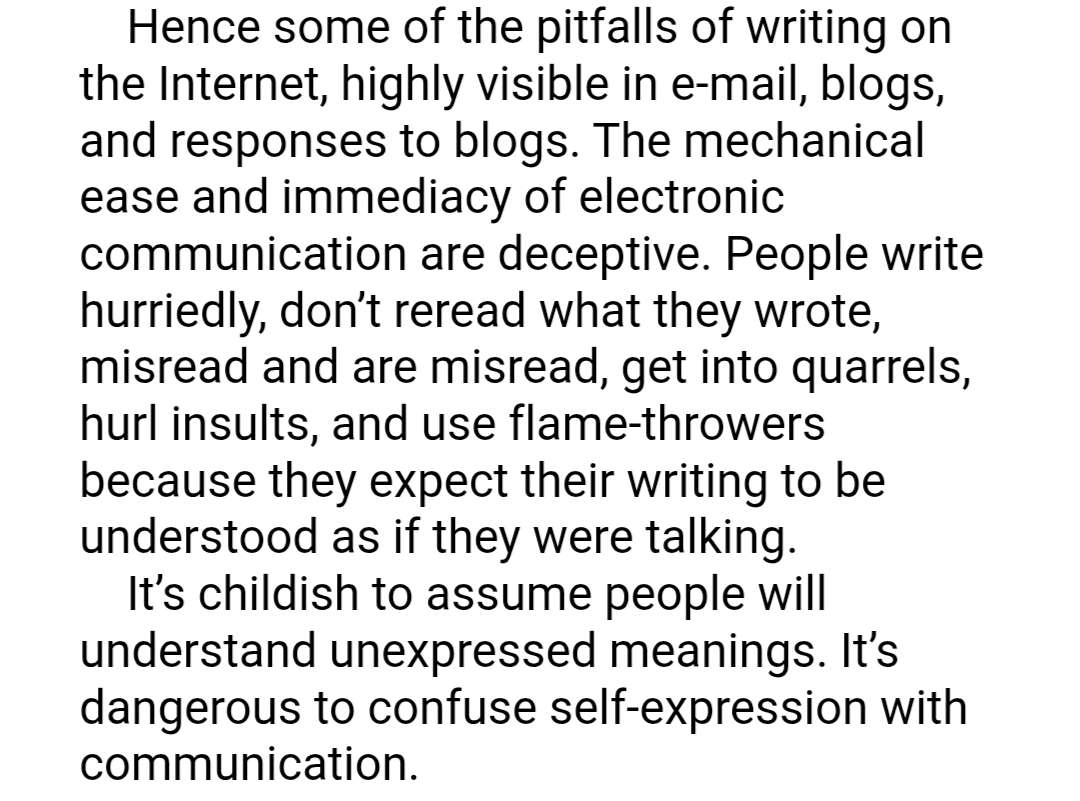
I’ve been thinking about this Ursula K. Le Guin quote a lot recently
4 Likes
Idk if you meant on the Internet or in person or both, but I find it happens on the Internet more often or at least it’s more frustrating when it does
4 Likes
Anyway
It’s dangerous to confuse self-expression with communication.
This goes hard.
6 Likes
I find that in-person conversation can also enhance misunderstandings because people speak hastily. It’s not turn-based, there’s more time to make mistakes. I often find myself coming away from in-person conversations having realised I’ve completely misrepresented myself in a way I don’t online conversations because I have less time to think
3 Likes
I think a lot of people are super harsh on online communication in a way that’s unwarranted, they say it’s impossible to communicate online because that’s not what they’re used to. People act like it’s a pitfall inherent to internet writing, when it’s more… a pitfall inherent to translation, which comes up when people are translating a spoken meaning to a written one and missing nuances because they expect them to be equivalent.
3 Likes
I tend to prefer in-person conversation with people I know in-person and online conversation with people I know online. And in the situations where I prefer in-person conversation, it’s usually because it’s quicker and gets the damn thing over with, as opposed to online conversation, where I feel obligated to think myself out and thus also wait for others to think things out.
I think that literal tone of voice is less necessary to communication than people think. I think the problem is that most people don’t know how to communicate without tone of voice.
3 Likes
Both, granted i dont know any openly self identifying autistic people in bulgaria (i live in the province). But neurotypical ppl both online and irl, i keep finding myself in misunderstings with them
You mean for you it happens more often on the internet? Other people misunderstanding you?
1 Like
I think… the quote is kind of weird, because it sort of applies a standard of “pieces of writing” to internet flamewars, sort of saying people are essentially trying to do writing but expect to be understood as if they are talking, and that they should instead be writing better.
I think it’s often more reasonable to analyze internet flamewars as a weird kind of talking than a weird kind of writing… or a blend of the two. Like, the aims of internet communication are not the same as writing, it is literally immediate, that brings a different set of strengths and weaknesses.
I had this same criticism of my secondhand experience with Sarah Schulman’s writing: she comes at it from the opposite perspective, seeing the internet as “a bad kind of talking”. It’s not a bad kind of talking and it’s not a bad kind of writing. It’s a different thing from both, it’s a blend of them, it has its own advantages and disadvantages, and I think people who didn’t grow up with the internet have the instinct of trying to box it as one or the other and then criticising it for not fitting in such a box. It’s not either thing.
2 Likes
Yeah. More often on the Internet.
2 Likes
I speak in a very flat and unemotional tone irl (when my brain is focused on something, or im in a neutral mood). Ppl often perceive it as me being grumpy or angry or sad when im not. And the same thing happens to me online, when i speak in that tone due to being focused on something (such as a mafia game). Ive been called robotic both irl and online
1 Like
Like, I could speak of writing books as a bad kind of internet communication, and talk about how the medium allows authors to get so stuck in their own heads and isolated from conversation or criticism that they fail to notice obvious flaws in their arguments, that the slowness of it enables endless editing and rewriting that completely detaches people from communication with a person rather than perfecting some kind of personal work.
Or I could speak of talking as a bad kind of internet communication, where people have no time to think about what they’d like to say, nor an ability to go back and edit before their point is out, which encourages hasty judgements and things someone didn’t mean.
It’s just odd to talk about things that way. It’s a different medium.
2 Likes
Like, you can compare a medium to another, obviously, and I think the quote is somewhat insightful as a comparison on medium conventions, on the relative disadvantages of the internet to writing. But, as I’ve said several times now, I think it steers much more on the side of… like, analyzing the internet as A Bad Kind of Writing, which is just really not what it is.
2 Likes
I have been thinking lately about just how difficult communication is.
I tried to ask my professor to send me interesting papers about biocatalysis for a project I was working about and he thought I was asking for him to send me mental health resources…
4 Likes
I don’t think that’s what she was trying to say? I feel like I understood what she was saying and empathize with that experience and seeing it play out in real time.
2 Likes
tutuu
how are you
4 Likes
Like when we talk to someone else in person, there is a ton more information being exchanged and context than on the Internet, but we are not consciously compensating for that. We’re writing as if we’re talking, as if our interlocutors have all of that extra information. I don’t think she’s necessarily criticizing it, but rather saying it’s important to recognize the shortcomings of the medium. I’ve had arguments with someone that lasted awhile, and I later realized it was founded on mutual misunderstanding early on. That’s a much more likely occurrence on the Internet because of how we try to communicate on it.
4 Likes
In my first uni one of my classmates called me on the phone once and asked me if i wanna come to a frat party. I replied “im not in the mood”. He sounded visibly extremely upset at me, he replied “well, okay, fix your mood” and hung up. I got really frustrated because i couldn’t understand why he got upset at me. Much later, ive realized that its good manners to tip toe when you reject an invitation, or straight up lie, like “oh thanks for inviting me! Ill see if i have the time!” (Lie, you wont see if you have the time, you already know you feel bad and dont wanna party). And also you are supposed to feign interest with your intonation. Fmpov he was asking me a question, and i just answered it, in my usual flat tone, i expected he would say “okay” and thats that, no frustration involved, so i was extremely shocked at his reaction
A similar thing happend once when i was a kid, when my mom asked me “how are you eating this dish without salt” (her dish). I replied “im used to eating bad food” (implied her dishes). She got visibly upset at me, and i was again really frustrated because i couldnt understand why. Fmpov she asked me a question, i tried to figure out the answer, and i gave her a good faith answer. I now know why she was upset, obviously, but her behavior was completely erratic fmpov, back then
2 Likes
Hi atly 

Im oki, how are you?
3 Likes
I tried to invite a friend to dinner and got cancelled on unexpectedly. Later, I was informed that he’d thought he could come after his “all-day” frat event, but didn’t realize that “all-day” includes the night…
4 Likes
if we’re going by your definition i’m also “oki”
2 Likes